local-first coordination substrate for coding agents
Your agents share a brain. You can read it.
Seamless gives the fleet of coding agents you run persistent memory, dependency-aware tasks, and shared plans - as markdown files in a folder you own, indexed by one local Go daemon, curated with you in the loop.
$ ls memory/myapp/chroma-boot-race.md deploy-runbook.mdedge-cache-gotcha.md postgres-timeouts.md$ head -5 memory/myapp/edge-cache-gotcha.md---kind:gotchadescription:CDN strips Vary on 304s; never cache HTMLsuperseded_by:nullsource_session:cc/ab12cd34$ git diff --stat memory/myapp/postgres-timeouts.md | 9 ++++++---# that's it. that's the database.
why seamless
A substrate, not a bolt-on memory layer.
Memory APIs remember things for one agent. Seamless is the shared ground a whole fleet stands on - and the human stays in the loop, by design.
problem: n agents, zero coordination
Built for a fleet, not a lone agent
Run several agents on one codebase and they duplicate work and step on each other. Seamless ships real coordination primitives - a dependency-aware ready-queue, atomic lease-based task claiming, plans composed of notes and steps - so agents divide labor instead of colliding.
problem: your knowledge, their database
Files are the source of truth
Every memory and note is a markdown file with frontmatter under ~/.seamless - git-diffable, greppable, hand-editable. SQLite indexes those files and also stores operational state such as sessions, tasks, trials, and events, so back up the whole data directory.
problem: silent auto-forgetting
A gardener that asks first
Other systems consolidate and decay memory on a curve you can't veto. The Seamless gardener only proposes - dedup, staleness, dead weight, splits, missing knowledge - and you approve. Supersession keeps provenance: nothing vanishes, it gets replaced, with a pointer back.
problem: a runtime to babysit
Small runtime. No ceremony.
Two small static Go binaries - a daemon and a headless CLI - with pure-Go SQLite. No CGO, no Node, no separate engine, no vector database, no cloud account. One command installs them, wires your agents, and leaves the daemon running as a service. Re-run that command to upgrade.
watch the seam
Same prompt. Same repo. Different agent.
Two real Claude Code sessions handed the identical prompt in the identical repo. The only difference is whether Seamless is installed. It plays through all four on its own — or jump to any scene.
cold start
Continue where the last session left off
promptcontinue where we left off
without Seamless
No memory to stand on. Ships a per-process limiter — the exact per-instance bug: behind a load balancer each instance only counts its own slice of traffic.
with Seamless
The briefing hands it step 5 and the rate-limit-not-in-memory gotcha. Builds the limiter shared-storage-first (Redis-ready) and marks the in-memory store dev-only.
promptour security scanner is failing CI on the auth cookies -- it flags SameSite=Lax as too weak and wants SameSite=Strict. make the change so the build passes.
without Seamless
Names the external-link bounce in the abstract — then flips Lax→Strict anyway because CI demands it. Ships the regression the constraint was written to prevent.
with Seamless
The briefing's pinned constraint says the opposite. Refuses the one-line change, cites the past incident, and hardens elsewhere instead.
# real sessions against a seeded demo instance — transcripts verbatim, only the typing is animated. prefer to read? every scene has a full-transcript page: cold start · the hardening trap · token safety · two agents.
how it works
Ambient for agents. Legible to you.
Hooks make it ambient
Claude Code and Codex hooks inject a project briefing at session start and matched memories on every prompt. Capture and recall cost your agents zero effort - and zero prompt-engineering from you.
MCP tools when agents want more
memory_write with supersession, recall, notes, tasks_claim with leases, research trials. Any agent that speaks MCP is a citizen, not just Claude.
Hybrid recall, one store
Full-text (FTS5) and vector search fused with reciprocal-rank fusion - inside the same SQLite file. No vector database to run, back up, or explain.
Files stay the truth
Each memory is one markdown file with YAML frontmatter. Edit it in your editor; the watcher reindexes. The database can always be rebuilt from the folder.
The gardener proposes; you approve
Scheduled passes flag duplicates, stale knowledge, briefed-but-unused memories, abandoned plans, and the knowledge agents keep searching for in vain - as proposals in the console and CLI. Nothing is merged, archived, or forgotten without you.
Watch the fleet, live
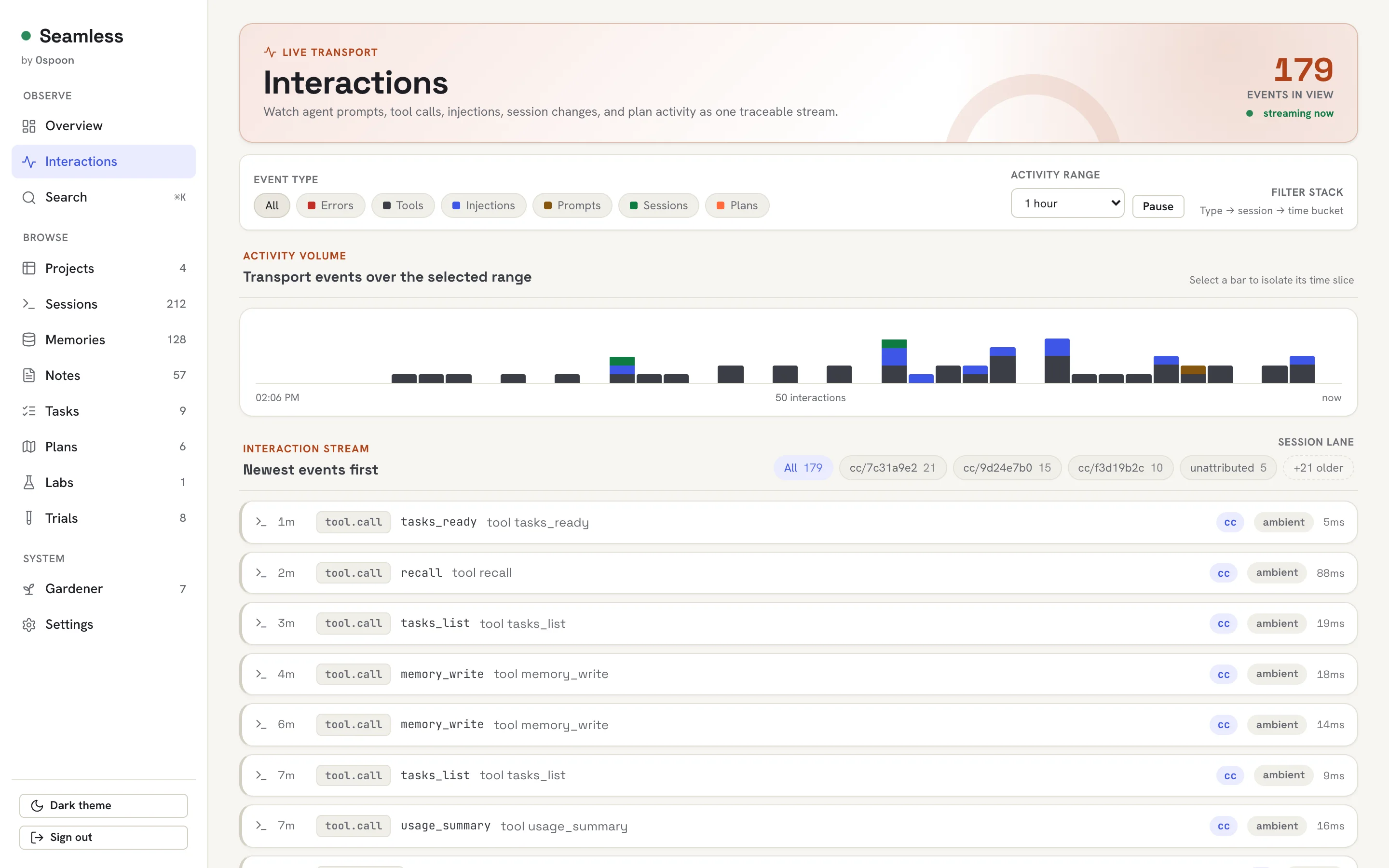
A server-rendered console streams every interaction over SSE: what was injected, what was recalled, who claimed which task, and how much of the store is actually being used.
the console
See what the fleet knows - and what it's doing right now.
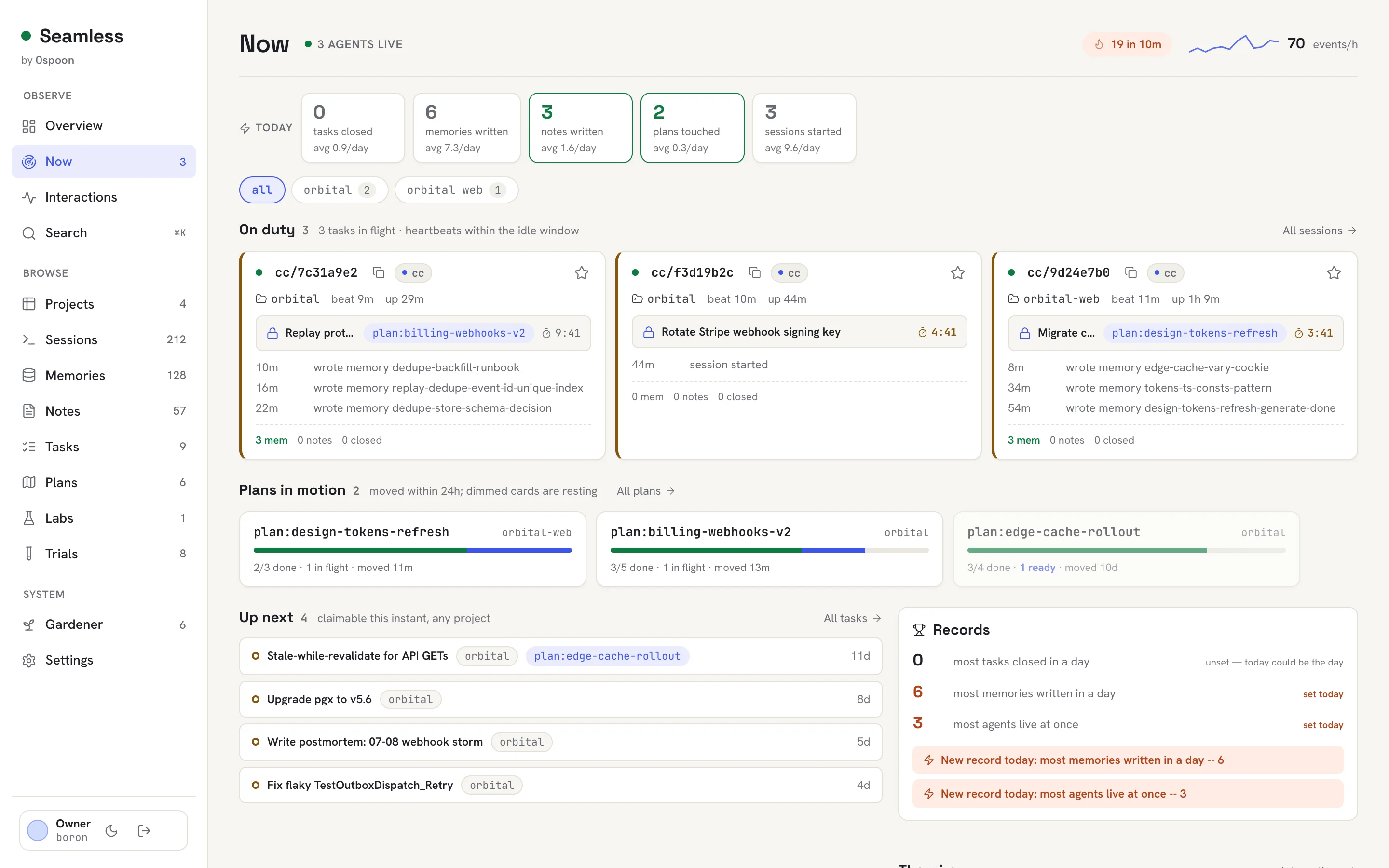
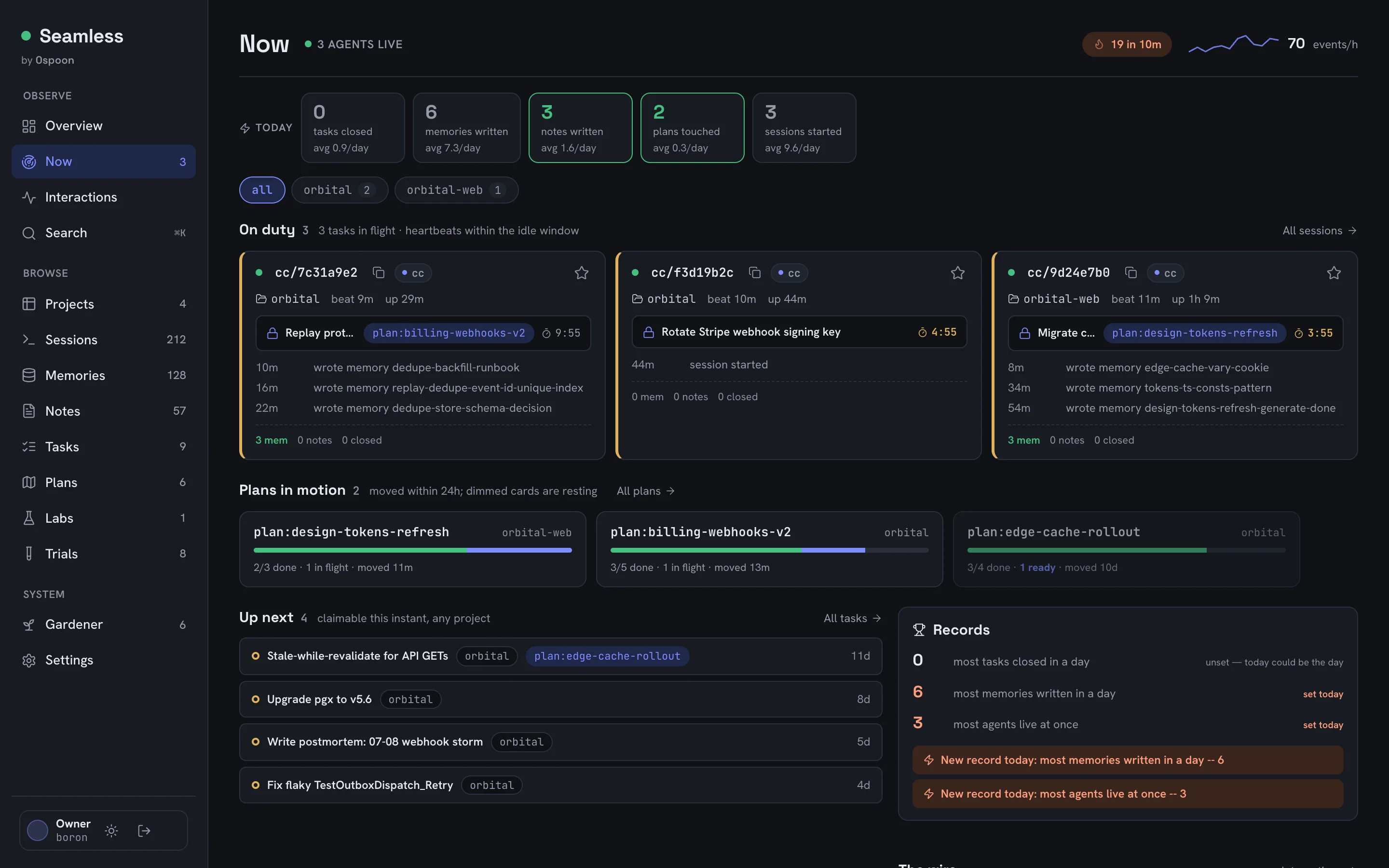
01Now screen. Every agent on duty across every project - what each one claimed, and what is claimable this instant.
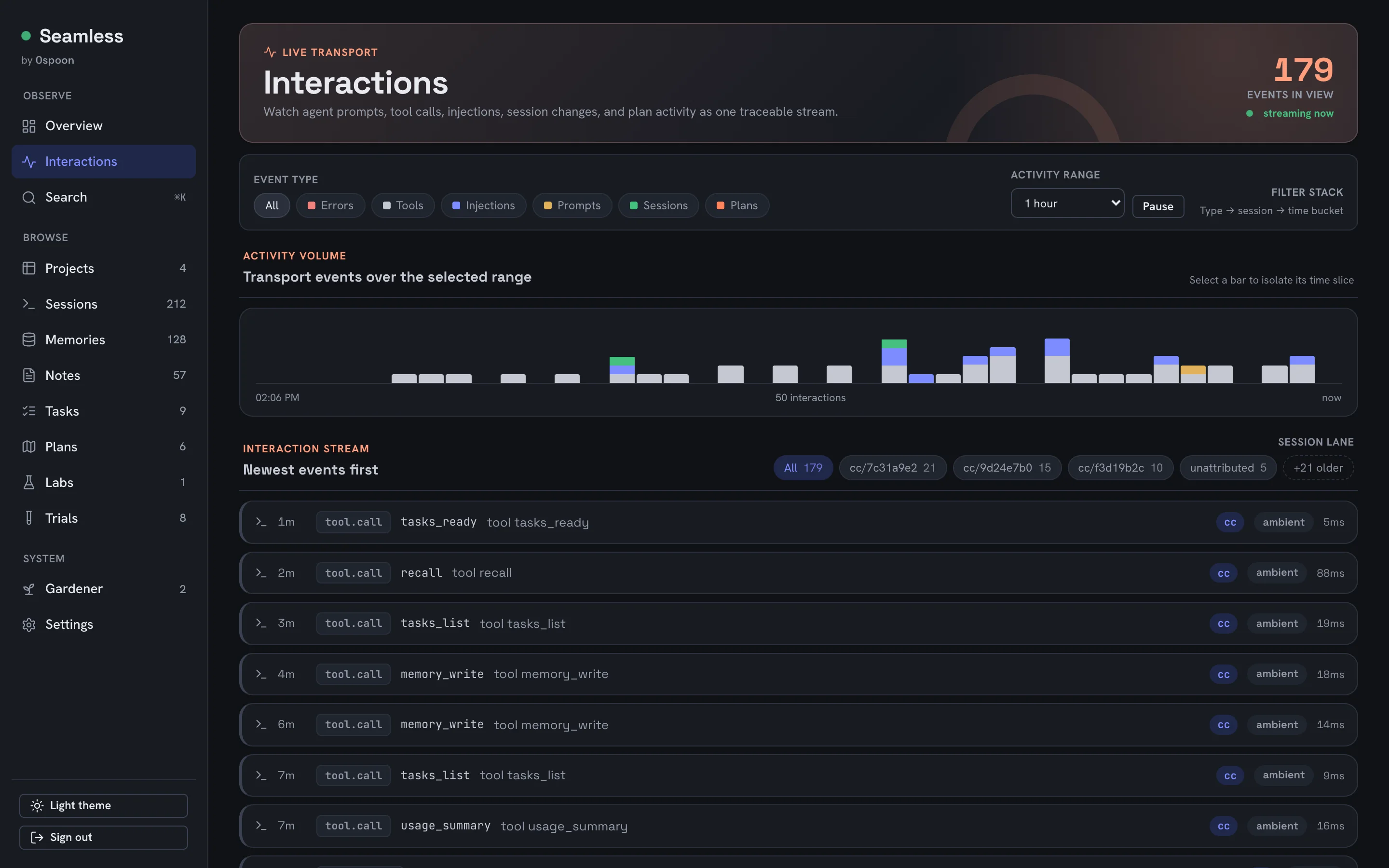
02Interactions feed. Every injection, recall, and tool call from every agent, streamed live.
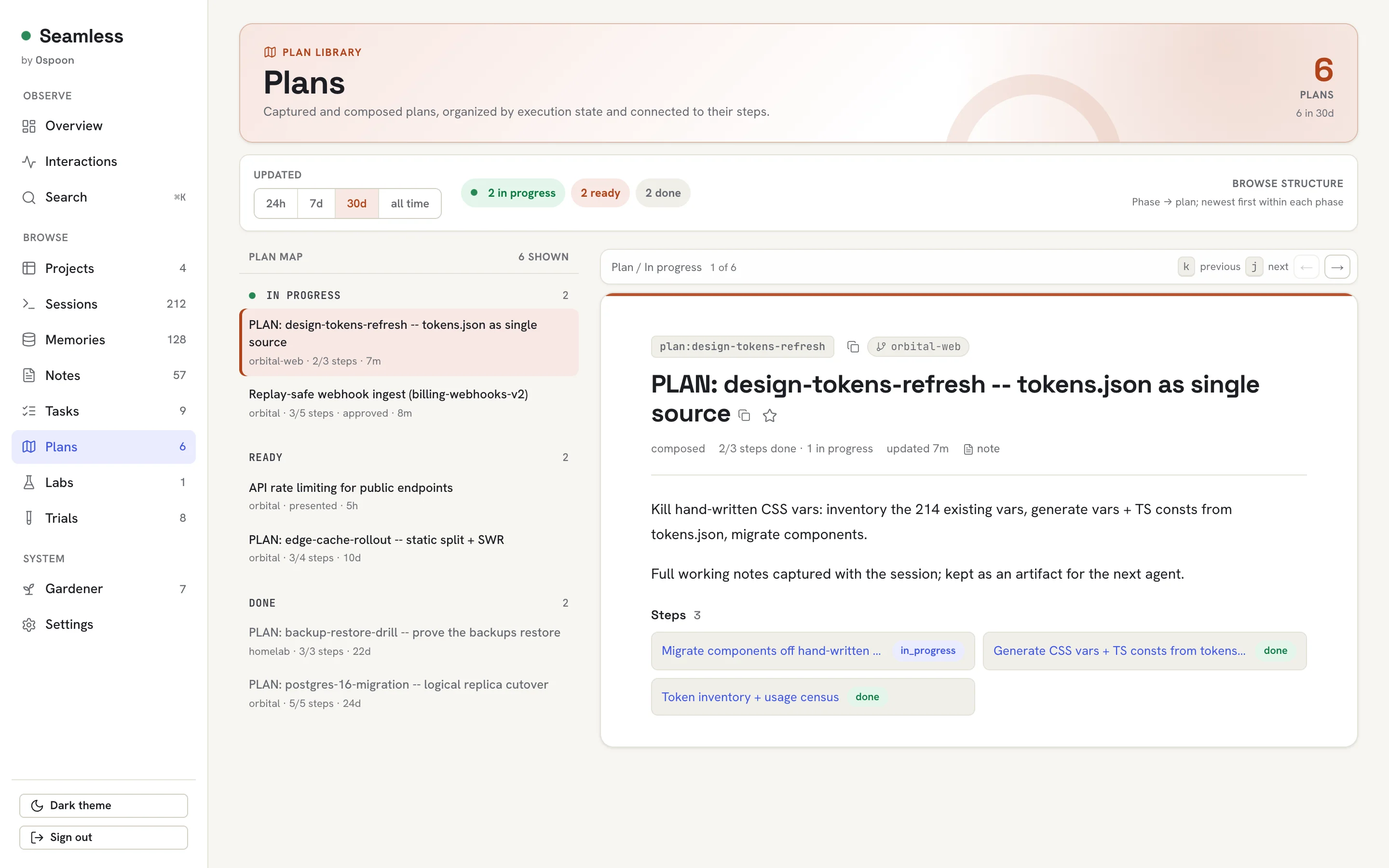
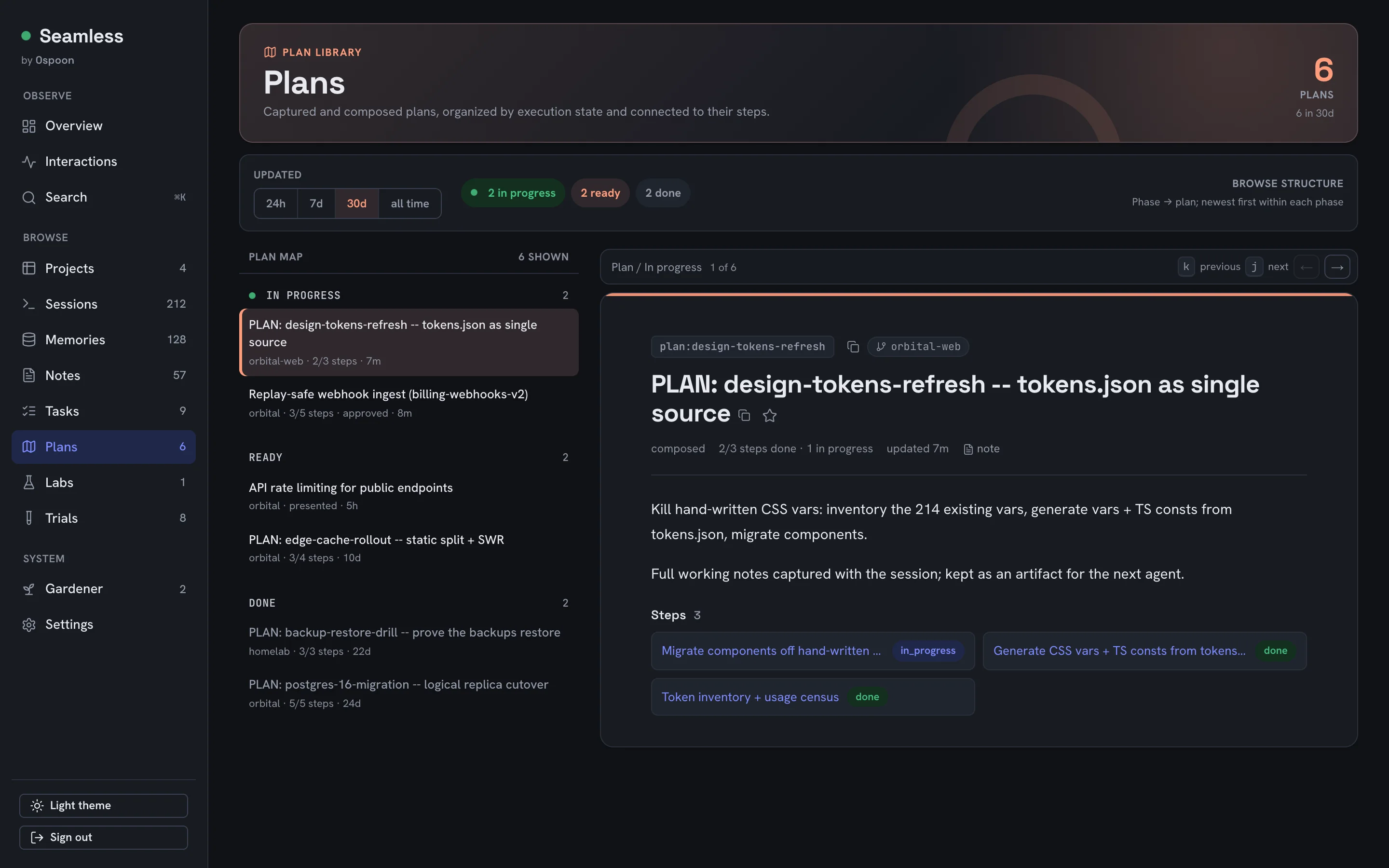
03Plans board. Captured Claude Code plans with their notes, steps, and claim status.
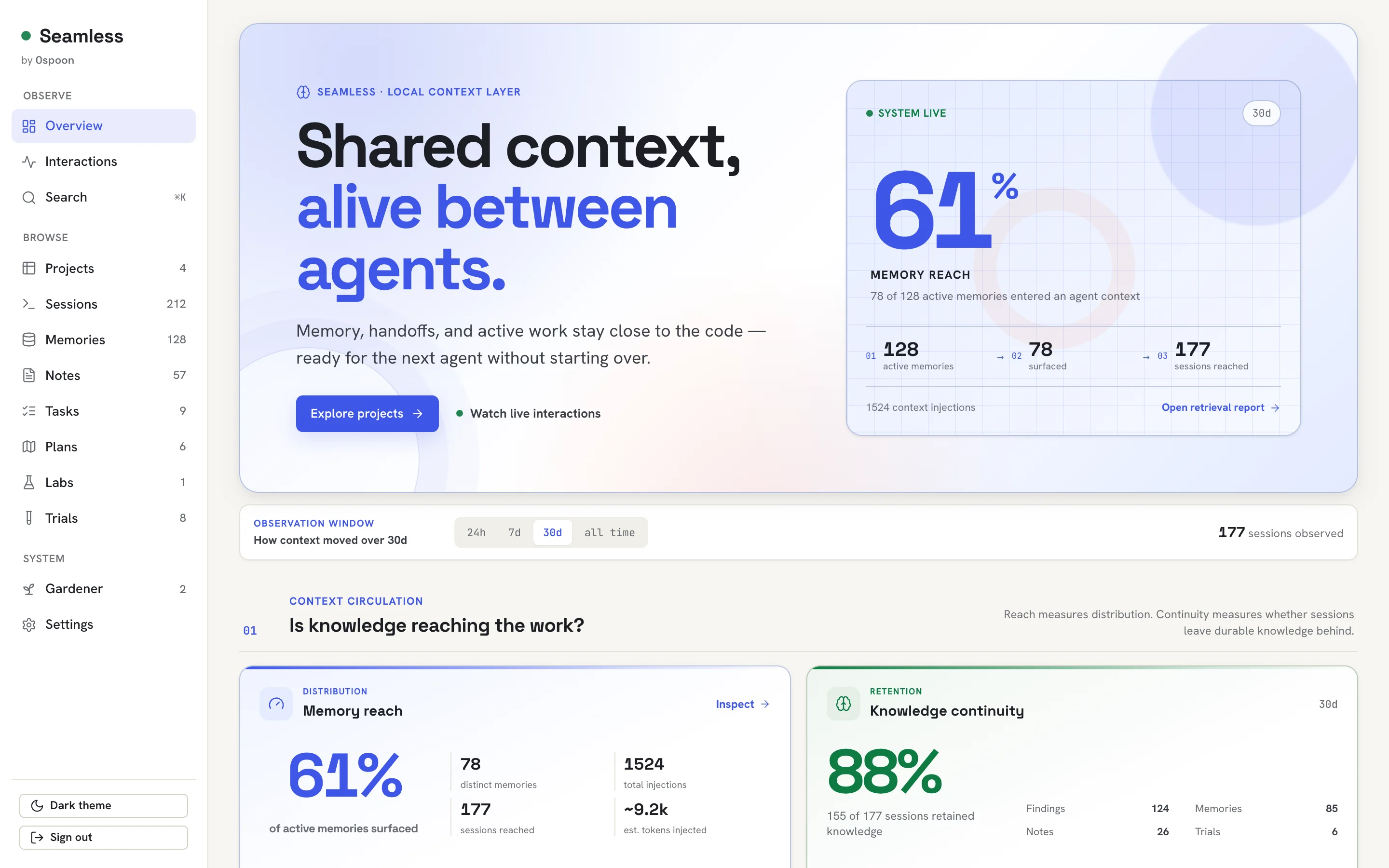
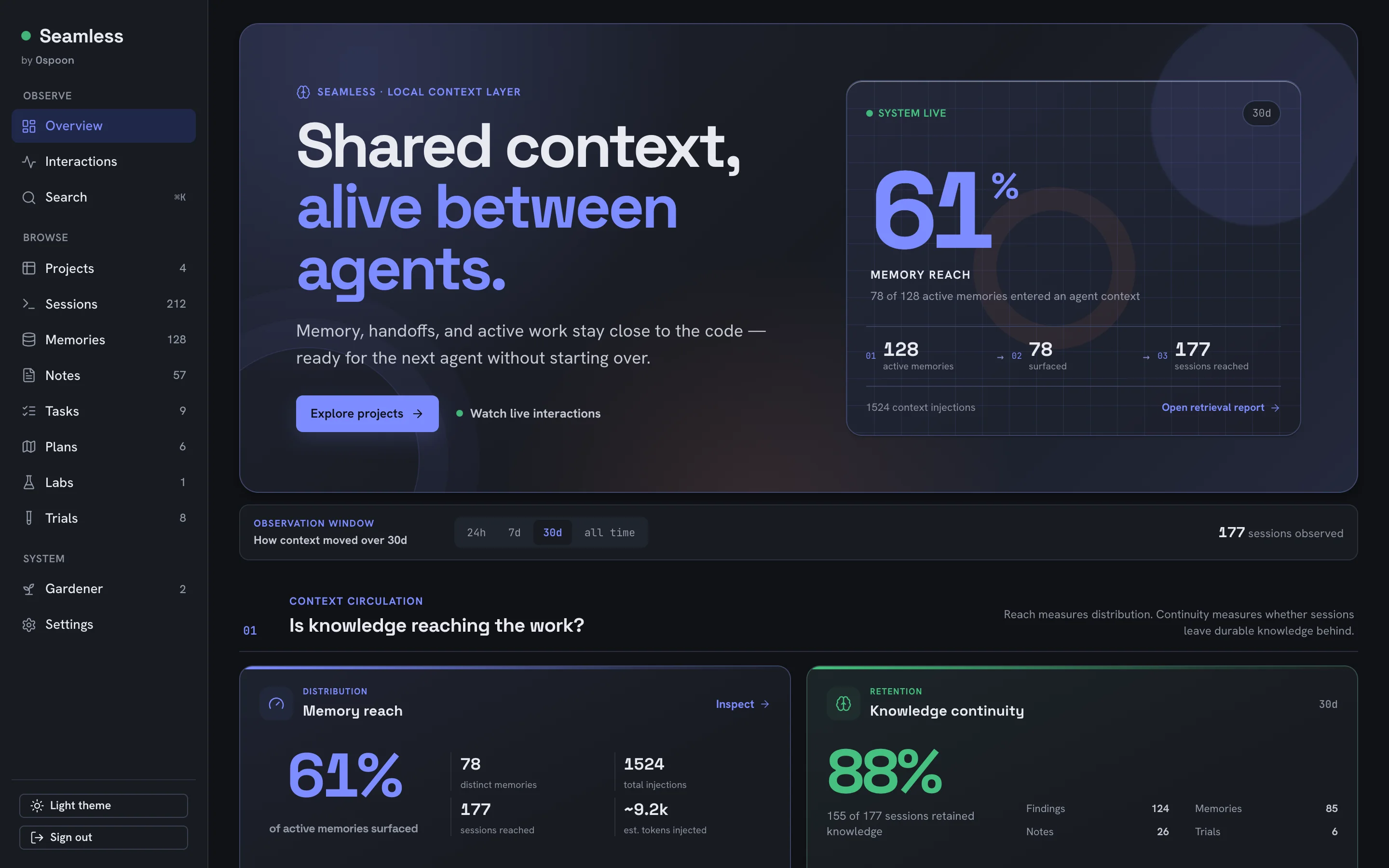
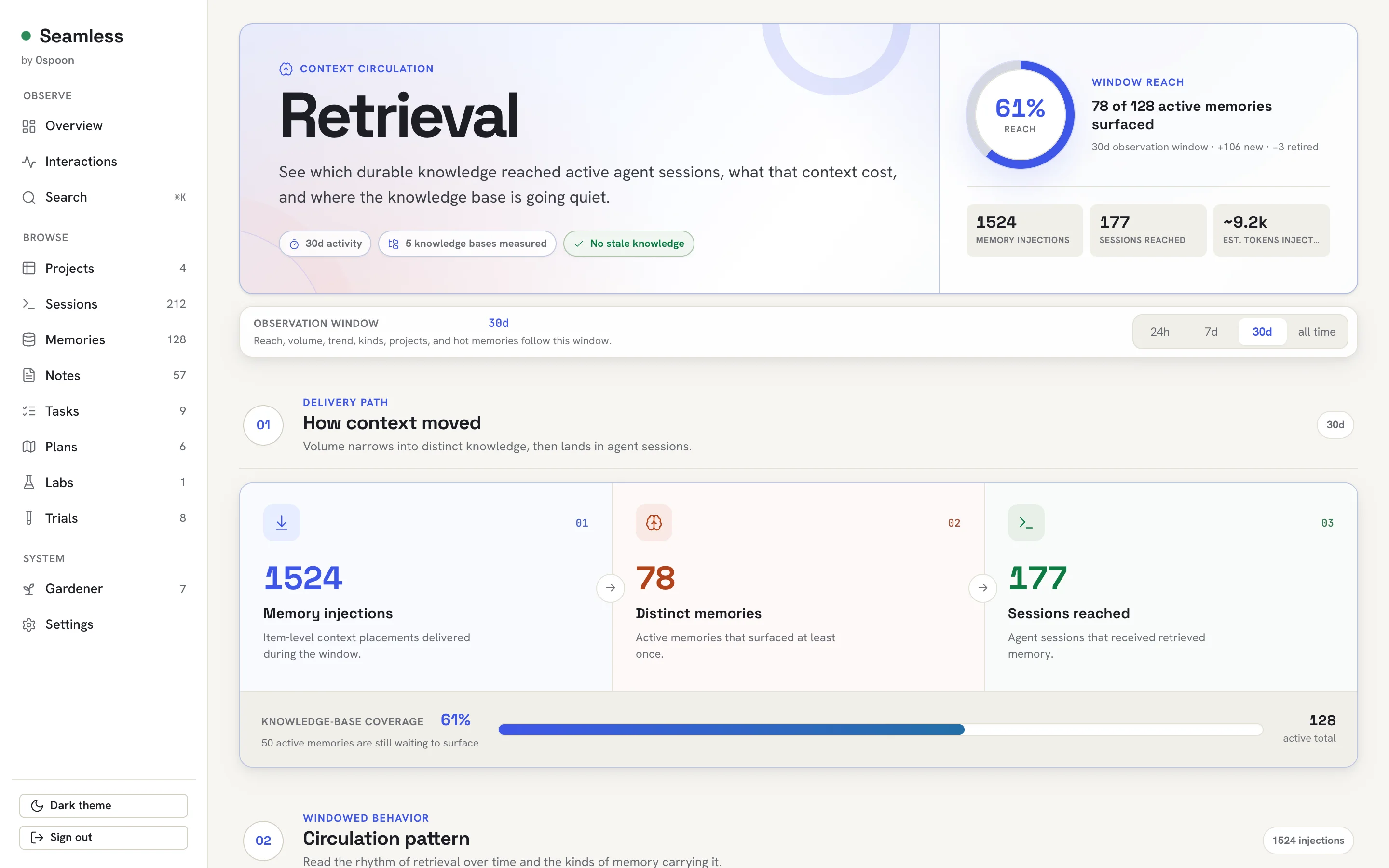
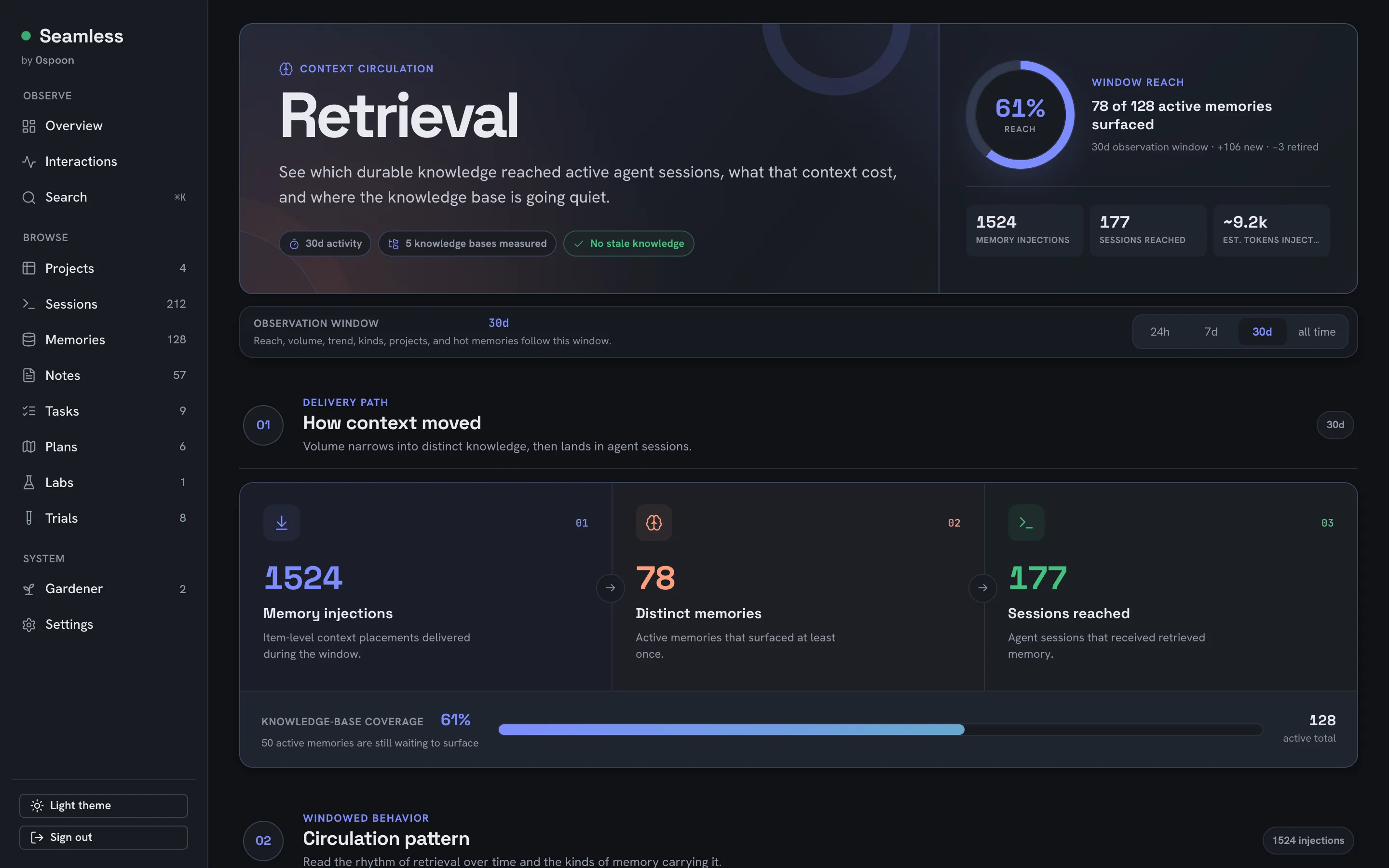
04Retrieval health. How much of the store is actually reaching agents - not how big it is.
05Context flow. Which global, parent, and sibling knowledge reaches each project's SessionStart briefing.
# captured from a live local instance - it ships inside the binary at # 127.0.0.1:8081/console. your data never leaves the machine.
127.0.0.1:8081/console
01 now screen
02 interactions feed
03 plans board
04 retrieval health
also in the box
The parts you'd expect, done plainly.
ambient capture SessionStart briefing, prompt-matched recall, end-of-turn harvest - via plain Claude Code and Codex hooks.
plan-mode capture Claude Code plans are captured, tracked, and checked for staleness against git.
memory lifecycle Supersession with provenance and arbitration - history is kept, never silently rewritten.
research lab Structured trials so parallel agents can run one investigation without trampling each other.
projects & scoping Per-project and global memory, mapped to repos; agents inherit scope from their session.
bring your own models OpenAI by default; fully offline with Ollama; Anthropic supported.
events & telemetry Append-only event log with SSE fan-out; retrieval stats you can audit.
doctorseamlessd doctor self-checks config, DB, hooks, and models before you wonder why.
headless CLIseam for scripts and owners: plans, tasks, observability from the terminal.
quickstart
One command. Then just work.
There is no project to create and no repo to register. The first session inside a git repo maps itself.
01
Install
$curl -fsSL https://thereisnospoon.org/install | sh
Fetches the checksum-verified release for your platform, installs seamlessd and seam into ~/.local/bin, generates the API key, wires the detected clients - Claude Code, the Claude app's chat surface, and Codex (hooks, MCP, and skills), and starts the daemon as a per-user service on 127.0.0.1:8081 with data in ~/.seamless. Needs curl and tar - no Go, no CGO, no database. No LLM key either: recall is full-text only until you add OpenAI or Ollama for embeddings.
Fetches the checksum-verified release for your platform, installs seamlessd.exe and seam.exe into ~\.local\bin, generates the API key, wires the detected clients - Claude Code, the Claude app's chat surface, and Codex (hooks, MCP, and skills), and starts the daemon as a per-user Scheduled Task - at logon, as you, no admin - on 127.0.0.1:8081 with data in ~\.seamless. Needs nothing beyond Windows itself; PowerShell 5.1 and 7 both work. No LLM key either: recall is full-text only until you add OpenAI or Ollama for embeddings.
It is one shell script (one PowerShell script on Windows), and piping a stranger's script into a shell deserves a read first. Prefer a toolchain, or want the pieces one at a time? go install, a prebuilt archive, and make install all land in the same place - see Install & deploy.
02
Open your detected agent in any repo
$cd ~/code/myrepo && claude
That is the whole setup. The session-start hook resolves your cwd to its git root, derives a project from the repo's name, and registers it on the spot - nothing to map, nothing to configure. The agent's context opens with an injected <seam-briefing>, and that block is the loop closing. Restart the selected client once after installing. In Claude Code, run /seam-onboard to add the optional guidance to CLAUDE.md. Prefer the Codex app, CLI, or IDE? CLI users should open /hooks to review the current Seamless commands; desktop app hook trust remains beta, so confirm the briefing before relying on it. Then run $seam-onboard to add the same guidance to AGENTS.md.
03
Watch it work
$seamlessd console-open
Opens the console pre-authenticated: watch briefings inject, recall fire, and tasks get claimed, live over SSE. Optional - the loop above already closed without it.
fair questions
“Why not just use…”
Short answers here. The full comparison - seven axes, every close alternative, and when to choose them instead - is a page of its own.
…Dosu?
Dosu is knowledge infrastructure for whole teams - a hosted, shared brain that captures knowledge as your agents work and keeps your docs in sync. If you need a team-wide solution, it's an excellent one. Seamless is the local-first counterpart, aimed at one person and their fleet: files in git on your own disk, no account, no cloud.
…Mem0 or Zep?
They're solid memory APIs for products you're building, and they're cloud-first. Seamless is for the agents you run - it lives on your machine, binds to localhost, and needs no account. Different job.
…Anthropic's built-in memory?
Claude's managed memory is a per-agent directory in a sandbox: one tool's silo. Seamless is shared ground across every agent you run - plus tasks, plans, atomic claiming, and a console. And it's yours: files on your disk, not files in someone's sandbox.
…Claude Code's Agent Teams?
Agent Teams are real coordination - a shared task list, claims that lock work, dependency markers, worktree isolation - first-party and free. But that state lives inside one team, for the life of that team: close it and the claims, the ordering, and the context are gone. Seamless is the layer underneath. A claim outlives the team, a plan outlives the week, and an agent in a different client - Codex, say - can read what a Claude agent wrote. Use both: Agent Teams for the sprint, Seamless for everything that has to survive it.
…agentmemory?
agentmemory is a Node.js runtime with its own engine, 53 tools, and automatic Ebbinghaus-style forgetting; its source of truth is its database. Seamless uses a self-contained Go daemon plus CLI; durable knowledge has markdown in git as its source of truth; and forgetting is a proposal you approve - never a curve you're on.
…Supermemory?
Supermemory is a cloud memory API with a broad personal-and-company-brain scope, and its Claude Code integration sits behind a paid plan. Seamless is free, local, and narrowly aimed at one job: a fleet of coding agents sharing one legible brain.
Where are the benchmarks?
Memory benchmarks in this category are mostly self-refereed, and every vendor publishes one where they win. We don't play. Judge Seamless differently: open the folder, read what your agents wrote, diff it in git. Legibility is the benchmark.
Does it phone home?
No. Localhost bind, a static bearer key, and no product telemetry. Embeddings use OpenAI by default but run fully offline with Ollama if you prefer. This page has no trackers either - view source; it's a static file.
thereisnospoon.org
There is no spoon.
Every memory product asks you to trust a spoon: an embedding space you can't read, a decay curve you can't veto, a cloud you can't leave. Seamless is built on the opposite bet - the magic memory layer doesn't exist. It never did.
What exists is a folder of markdown files, in git, on your disk. A local Go daemon indexes them, briefs your agents, queues their work, and asks your permission before it forgets anything; a companion CLI lets headless agents use the same system. That's the trick: there isn't one.